
SKIING IN THE HIMALAYAS: WHERE? WHEN? AND FOR WHOM?
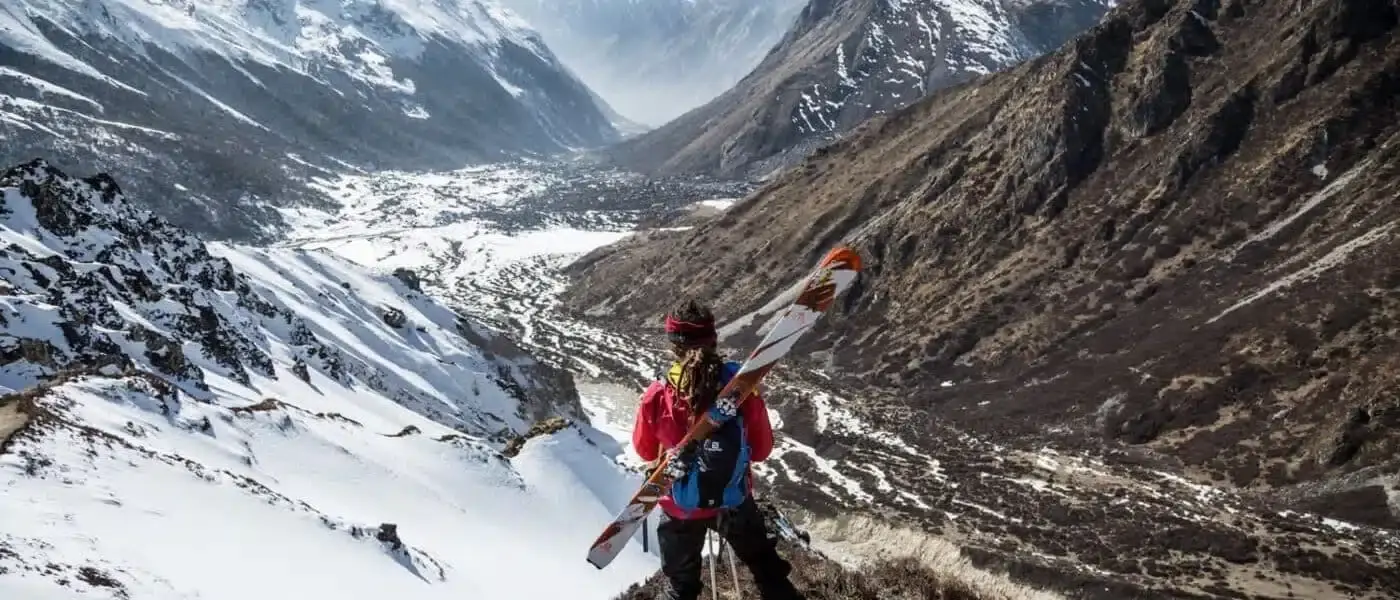
If you're looking for ever-changing snow and the most beautiful mountains on the planet, surrounded by forests and lush jungles, and wonderful people who will make your visit feel right at home, you should consider taking your skis to the Himalayas.
There's a question that always comes up when I'm with backcountry skiers lost in some unknown mountain range: "What's the best place to ski on the planet?"
And I, well, I'd say that's a very difficult question. It all depends on what you're looking for. If you're looking for perfect powder and great descents, then Alaska might interest you. If, on the other hand, you're looking for unknown, wild, and very difficult-to-access places, you could think about the Arctic, but if what you're looking for is ever-changing snow and the most beautiful mountains on the planet, surrounded by lush forests and jungles and wonderful people who will make you feel right at home, you should consider taking your skis to the Himalayas.
Table of contents
WHERE? WHEN? AND FOR WHOM?
The Himalayas are a very long mountain range, stretching for many kilometers between Bhutan and Pakistan. Along this length, the amount of snowfall varies considerably depending on the region, particularly whether it lies north or south of the range. This snowfall is linked to precipitation patterns and, above all, to the influence of global weather patterns.
The three questions present an equation with three unknowns and multiple correct answers, all of them intertwined. To simplify the equation somewhat, we will focus on Nepal.
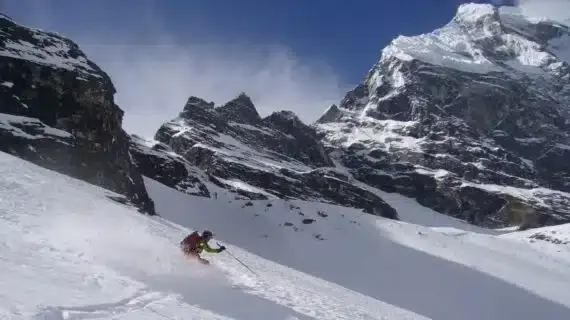
WHERE DOES IT SNOW THE MOST IN NEPAL?
From Everest to Manaslu, passing through Langang, there are areas with a lot of snow; we begin to venture into the valleys that remain white for most of the winter.
From Everest to Manaslu, passing through Langang, there are areas with a lot of snow; we begin to venture into the valleys that remain white for most of the winter.
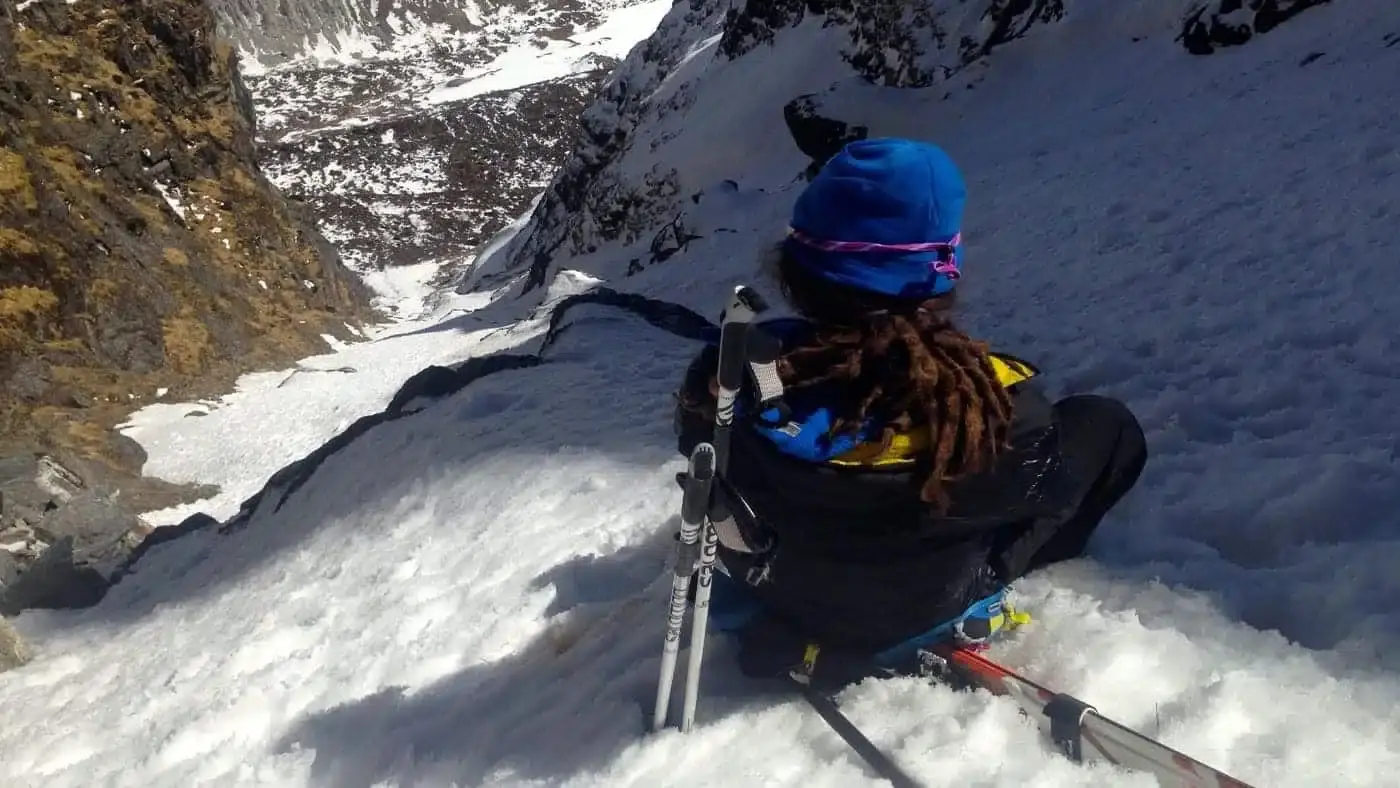
WHEN SHOULD WE GO SKIING IN NEPAL?
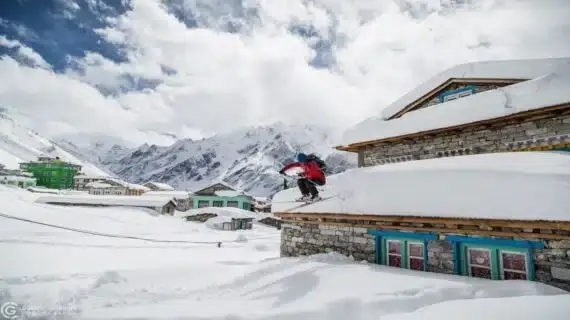
The “when” is linked to what type of activity we want to do and how much time we have to do it.
The first thing to understand is Nepal's rainfall pattern. Nepal doesn't have four seasons like our country: spring, summer, autumn, and winter. The rainfall pattern is dictated by the monsoon.
Winter in the Himalayas:
It's a very cold season. It begins very dry during December and January. It's not until late January and February that humid air masses can penetrate the mountains and heavy snowfall begins. Another characteristic of winter is that the jet stream, very violent winds at high altitudes, is very low in the atmosphere. This means that above 6,000/6,500 meters, any snow that falls can't stay; it's literally blown away by the strong winds. It's the ideal time for skiing in the valley bottoms (never below 4,000 meters). If you only have a few days, it's the perfect time; you won't need many days to acclimatize.
The pre-monsoon:
Spring is defined by a rise in temperatures that melts the snow in the valleys, restoring the green of the rainforests. Perhaps the last snowfalls coincided with the rise in the jet stream's altitude, and the peaks of 6,000 and 7,000 meters remained white. We can divide this period into two parts:
- From late February to early April we can enjoy excellent mid-altitude snow; it's the season to practice heliskiing in the Annapurna area.
- From mid-April to mid-May is the ideal time to ascend eight thousand miles on skis. But keep in mind that we'll encounter very hard snow, windblown snow, ice…
The monsoon:
It lasts approximately from June to early September and is characterized by heavy, continuous rainfall and high tropical temperatures. While rainfall in the valleys typically reaches 5500/6000 m, the high mountains accumulate large amounts of snow, and strong jet streams are very powerful in the atmosphere, so the snow remains on the peaks.
The post-monsoon:
The season begins in September, usually starting with a large amount of accumulated snow above 6,500 meters. Avalanches are a significant risk in many areas. This is the time to acclimatize and wait for the snow to settle. From early October to December, with its clear days, a gradually settling autumn chill, and calm winds, it's the perfect time to ski in the Himalayan giants.
We can do ski touring from 5,000m. Acclimatization days are necessary, as well as the ability to ski to peaks of 6,000, 7,000, and 8,000m. For years, we have run a “HIMALAYA ALPINE SCHOOL” every autumn in different areas of Nepal (from Langtang to the far west) and Pakistan. 8,000m ski season.
¿QUIÉN PUEDE ESQUIAR EN NEPAL?
The first thing to keep in mind is that we're skiing in the Himalayas. We're not skiing at a ski resort, with a rescue team, a helicopter, and après-ski waiting to get us out after a 10-minute phone call…
We need to have at least an intermediate level of off-piste skiing experience. There are routes of all difficulty levels, from easy traverses without any technical challenges to extremely difficult activities, so we can adapt the difficulty of the routes to the level of the group.
If you want to enjoy skiing in Nepal, at the foot of an eight-thousander with all the comforts and without great effort, Heliskiing on Annapurna in Spring is your best option.
If you only have a few days (minimum 10 to 15 days) and are looking for the best powder snow in Nepal, your best option is a getaway between February and March. northern area of Annapurna and the Langtang area, due to its easy and quick access, is one of the options.
If you have 25 to 30 days available, you can go in spring or autumn to do some descents in mountains from 5,500m to 7,000m.
¿QUÉ ES LA ESCUELA ALPINA DEL HIMALAYA?
For those who want to venture into the great peaks of the Himalayas outside of commercial expeditions, we have created this “Himalayan school”.
On October 15th, we begin this year's Himalayan Alpine School. This year's activities will take place in the northern area of Manaslu.
There is an under-exploited region with mountains between 6,400 and 6,900m, some virgin and several with the possibility of opening new routes of all difficulties, even with skis.
We manage all logistics up to base camp. The different teams can pursue individual objectives or join forces to achieve a common goal. They operate with complete autonomy, without fixed ropes or high-altitude porters, and are coordinated and advised at all times by Jordi Tosas and our team in Nepal.